Track Record
Those who hear not the music think the dancer is mad.
Today
Since 2022 I have worked as an independent advisor for design and technology. Right now I’m guiding the rebuild of a mid-sized company’s IT landscape.
Many old structures are dissolving, and not only in IT. Uncertainty is high, but so is the will to rethink things. What is needed now is leadership that brings people along and gives them security and self-confidence.
Efficiency now comes with the machines. Whether a product is also sustainable is decided before it is built: who it serves, how long it lasts and how much material and energy it consumes. No discipline can answer that on its own.
As a leader and entrepreneur I built and led multidisciplinary teams. I have always seen my job as creating the space, culture, methods and processes in which teams can do their best work.
1990 Training
In the early 1990s I trained in communication and graphic design in the team of Boris Kochan, founder of the Munich brand and design agency Kochan & Partner. We had our own offset print shop in the back courtyard. A platen press stood next to it. The typesetters sat at Linotype phototypesetting systems; the studio had Letraset, light tables and spray adhesive. In the next building there was a “wet” prepress (“the litho”), where image and text were assembled by hand and exposed onto printing plates. The hot metal type in the corner had not gathered much dust yet.
There I lived through the upheaval of an entire industry. We bought the first drum scanner and ordered – and marvelled at – the first Mac for desktop publishing with WYSIWYG. But nothing could replace the printer’s eye through the loupe.
The tools changed. The trained eye remained.
I was interested in how things fit together. Over the years I took on project management. At some point we developed applications and databases for project control and the management of content data. Software development was putting out its feelers …
Early on. Since 1995.
1995 Web
I was given my first modem in 1994. And a new world opened up, without established patterns or masters. When the web was still largely unknown in Germany, I co-founded peppermind at Kochan & Partner in 1995 – one of the first digital agencies in Germany. I saw the HTML standard gain tables – a revolution … Two years later I moved to Hamburg, the internet stronghold of the day, to co-found the German arm of the Swedish agency Spray Interactive. Through a merger it became Razorfish AG, which I led as CEO from 1999. Our motto: everything that can be digital, will be. For clients such as Audi, Gruner+Jahr and UniCredit we pioneered disciplines like information architecture and user experience in Germany and established them. We had built a successful, profitable business model and a unique company culture. Then came the crash. The hardest part was not the collapsing valuations. It was the conversations with all the people I had hired over the years.
2001 Mobile
At Spray we had already worked intensively on mobile services and technologies in the 1990s and, in partnerships with Nokia among others, developed future standards. I was there when the mobile internet learned to walk in northern Europe and its potential began to show. My “excursion” into industry followed logically: building and leading a think tank for Telefónica and Sonera (Quam) on the future of mobile communication. Six years before the iPhone. Among other things, we developed complementary Wi-Fi hotspot concepts for the 3G network that was only just being built. It ended up in a drawer. And I learned: the right strategies are worthless if they are not implemented. And that I was too young for corporate politics.
I changed roles again and turned to brands, corporate design and communication – back at Kochan & Partner, where I had started. From 2004 I was part of the management there and headed its consulting practice.
2008 Design Thinking
Four years at IDEO, as Managing Director of the German office and Associate Partner. Learning from the best. Back then design thinking was not yet an empty promise on board slides (“we put people at the centre”), but the lived design practice of small, highly specialised, international and multidisciplinary teams who achieved outstanding results with it. The books about it have already been written by others … What I was able to learn at IDEO still shapes my understanding of the role design can – and should – play in companies, but also in society.
The most important lesson: numbers show what people do. Only observation and conversation show why they do it, what they wish for and what they fear. For BBVA, more banking was to move from the counter to the ATM; the result was mimo, a banking experience that remains unmatched to this day. For a technology group we made electric mobility tangible as a prototype; for a sensor maker we developed a new principle of gesture control.
2012 Design Doing
The technological developments mattered too much to me to only place them in strategies from the outside. Research and prototyping alone were no longer enough – I wanted to get back to where products are built, launched and run. The truth lies in the application, not in the concept. So it fitted well when Matthias Schrader asked me whether I wanted to co-found and lead the Munich office of SinnerSchrader (now Accenture Song). No sooner said than done. From zero to fifty wonderful people in three years. For Allianz we created oneWeb, a global design system; for BMW in the UK, Europe’s first online shop in which manufacturer and dealers sell new cars together. Plus O2. Great success.
But I wanted to get even closer to the decisions and the responsibility for product and brand. So, 2015: three months for Exaring – developing the name, the brand and the first product design for waipu.tv. Today the market leader for IPTV in Germany, with around two million customers (as of March 2026). It shows what foundations can be laid in a quarter.
2016 Machine Learning
The concepts around artificial intelligence are as old as computer science, and I had been fascinated by them since the late 1980s. In the mid-2010s it became clear to me that, for the first time, the factors had come together that turn academic and literary approaches into workable possibilities: relevant central and mobile computing power, enormous and steadily growing collections of data paired with falling storage costs, and the fast, worldwide networking of all system levels.
When Ramin Assadollahi, inventor of word prediction and founder of ExB, approached me and asked me to build, as Director of Design & UX, the user experience for the application of their “understanding machine”, everything fell into place: working directly with people with a scientific background who were developing a trainable machine-learning platform. Our first goal was to make scientific and medical texts usable at industrial scale. And, “on the side”, to turn a ten-year-old start-up from a research lab into a product company. And: I wanted to understand whether and when the machines would take over. Well, I quickly understood: not that soon.
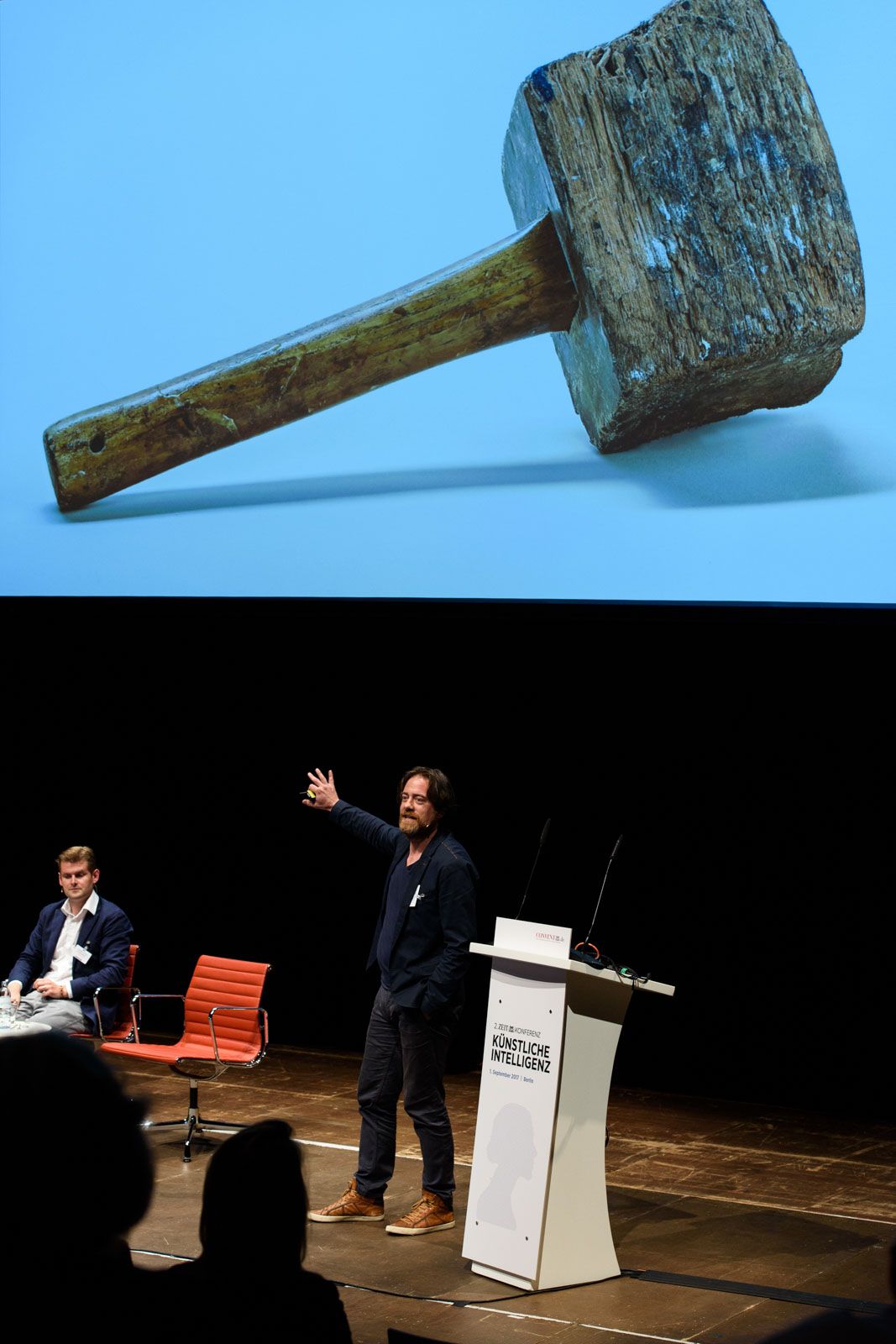
Even then, transformer architectures (the basis of today’s LLMs) were clearly one of the most exciting topics. But so were their limitations. We worked on interfaces for use, but also for annotation, on the problem of making the decisions of the “black boxes” traceable, on multimodality. Learned a lot, from people who know their craft. That is why for a long time I talked about machine learning and put “AI” in quotation marks.
The “on the side” turned into almost six years, until 2022: with agile product development, our own customer support and a newly founded technical documentation team. Among the products was the Cognitive Workbench, a trainable platform for companies. For a car maker we developed an in-car entertainment prototype that uses embedded machine learning to predict the behaviour of individual passengers from vehicle data and acts accordingly.
Then, in 2022, I went independent. A few months later ChatGPT came out. Suddenly anyone could try out what had occupied us at ExB – along with the limitations we already knew. I kept the quotation marks around “AI” a while longer.
2025 Agentic Systems
Software writes software; machines generate content for machines. The social, political and philosophical questions behind it are no longer theoretical but acute. Early again, confusing again.
As with the first DTP Mac and the dawn of the web: I work with it. I develop my own projects and products with AI agents and bring agentic systems into organisations. The more machines can build, the more it matters what has been understood beforehand: what people need.
The tools are changing again. Judgement remains our job.
30 years in digital · more than 200 projects in digital products, brand, industrial design, space and service · more than 300 people hired, more than 1,000 led · Industries: health and pharma, telecommunications, financial services, automotive, high-tech, media, travel, consulting.
I live in Munich. Three children, a music enthusiast with too many records (says my wife). Side project: vinylist.studio
Over the decades many people have entrusted me with something: a company, a team, a product, an idea, sometimes their professional future. And almost always I learned more than I gave.
To the people I was able to hire, to the colleagues I was allowed to work with, to the clients who took a risk:
Thank you.